Showing posts with label extreme sport. Show all posts

Friday, October 7, 2011

Extreme Cold: Wim Hof and Tummo

This week, I learned about a guy who can withstand extreme cold.  Here's a picture of him during what I can only believe must be normal bathtime for him:


This man is Wim Hof, and he gets cold professionally.  He holds the world record for being immersed in ice, 1 hour and 44 minutes.  He is known as the "Iceman."  He likes to go running and hiking wearing only a pair of shorts.  He ran a marathon north of the Arctic Circle wearing only shorts.


He also holds the world record for distance swimming beneath ice: 55.5 meters.  You can watch the video of him setting the record here:


He tried to climb Mount Everest wearing only shorts, but he failed due to a foot injury of some sort.  My favorite quote from Wim Hof is this: "Edmund Hillary's ascent of Mount Everest was a testament to human achievement; my climb of Mount Everest in my shorts will be a monument to the frivolous, decadent nature of modern society."

That's a pretty funny reason to do something.

Wim Hof practices the Tibetan meditation practice of Tummo, which somehow creates body heat.  There have apparently been some studies that show people's fingertips getting warmer during this meditation.  Something about chakras.  But who am I to question it, when the practitioners can do things like this:


(from care2.com)

Wim Hof uses Tummo to adjust his "mental thermostat" and keep himself warm while he climbs mountains barefoot, wearing only shorts.  He wins the Talus Slopes hardcore award of the week.  Here's to you, Wim Hof.

Friday, September 9, 2011

Free Soloing Videos

Yes, I have already posted about free soloing, the (crazy) extreme sport in which you rock climb without a rope.  You can read my past blog post here.  For all the people out there who worry about me, please know that I am in no way tempted to pursue this sport.  (Well, sometimes people go free soloing on short walls over a body of water.  I'd consider that, but that isn't really the same because of the distinct lack of DEATH involved.)

This week, I once again became fascinated about free soloing because of this video.  The guy in the video, Alex Honnold, has climbed some world-class routes like half dome and The Nose of El Capitán without ropes.  Seriously, watch this video:


Here are some still shots of Alex Honnold free soloing various routes, with some nice music by Emancipator:


I am in awe of this guy's abilities.  Seeing him climb is inspirational.  I am not tempted to try free soloing in the slightest, but I can sort of appreciate the beauty of the sport.  He must have such a sense of freedom when he's up on the rock (at least, when he's not in fear of falling).

Here's a video in which Steph Davis talks about her reasons for free soloing.  She talks about the freedom she feels up on the rock, and the sense of being in control.  She uses it as a way to work out other things in her life.


Watching that video, I'm just thinking that I can't really imagine climbing a ladder as tall as that cliff without a rope.  But Steph Davis is more hardcore than me.  She says that free soloing the diamond is "an expression of mastery."  Yup.

There are also people who free solo barefoot.

I don't even know, man.

To end our day of extreme vertigo, here is a video from Dad about the world record high dive from a few years ago:


Now there are butterflies in my stomach and I'm done blogging for the day.  Bye bye.

Friday, July 15, 2011

Extreme Sport of the Week: Free Soloing

Short post this week.  I mostly wanted to show you some inspirational photos and stories about rock climbing.  In particular, there is this crazy sport called free soloing, which is rock climbing to dangerous heights without a rope.  This goes on the list of things I'd never do myself, but please direct your attention to this article I found in the National Geographic:

http://ngm.nationalgeographic.com/2011/05/yosemite-climbing/jenkins-text/1

(from the flickr photostream of Rick Tew's NinjaGym™ Martial Arts)

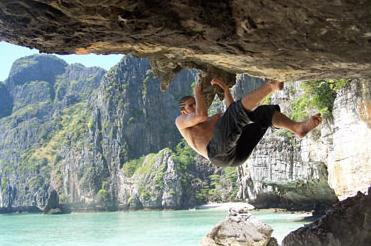
The above photo is of ropeless rock climbing at Phi Phi in Thailand, where my mom is vacationing right now, actually.  But it's not free soloing, because the guy is low enough that he could fall without getting severely hurt or dying.  

Free soloing... okay, fine, here's the awesome photo from the National Geographic.  I'm not sure if they allow others to use their images.  If they give me trouble, I'll take it down.  Until then:


Now take a look at the article that goes along with that photo.  Free soloing is stupid, scary, and awe-inspiring.

The article goes on from free soloing to talk about other rock climbing styles that are less stupid.  Feeling inspired, I went on to find this video of Lynn Hill and Katie Brown climbing together.  Lynn Hill is one of the best climbers in the world, and is mentioned in the National Geographic article.  May she inspire you as she inspires me:

Friday, May 20, 2011

Skydiving without a parachute

Today I learned about a new stupid thing you can do while falling!  You can jump out of a plane without any parachute attached to your body.  Then, presumably, someone will come along with a parachute, you'll attach it to yourself, and you'll coast down to safety.  It's a sport for those who have skydived so much that the feeling of falling no longer excites them... they also need to feel the very real threat of dying to get their heart rate up.  I guess it is also a trust exercise.  You'd better count on that friend of yours to bring your chute.  Here's an example:


Kind of fascinating, really.  Once that gets old, maybe we could start the guy out in a straight jacket?  Gotta keep raising the bar.

Now, I'm all for jumping out of planes.  Throwing yourself out of a perfectly functional plane is one of the most wonderfully surreal feelings around, and it's a great way to conquer your fear of heights, if you're into that.  Once you reach terminal velocity, falling is pretty relaxing.  Furthermore, skydiving parachutes have safety measures built in -- most of them will activate your parachute if you're below a certain elevation (I want to say 750 feet?) and haven't deployed your chute yet.  In other words, even if you pass out, there's a chance you'll be okay.

The idea of not using a parachute adds a new dimension, though.  Maybe some people want to face death.  Maybe people love the high they get from overcoming it.  Maybe they just want to feel more like James Bond.

And then there's this guy:


He has somehow managed to hide a parachute in his pants.  Yeah, I don't really know how that works for him.

Tuesday, August 10, 2010

Extreme Sport of the Week: Extreme Caving

Last week's post was long.  This one will be much shorter but it will be awesome.  There is only one picture, but stay with me here...

I've been doing some reading into extreme caving.  The really intense caving involves staying underground, often in pitch black to conserve light, for sometimes up to a month at a time.  It involves advanced rappelling equipment to get beyond sheer vertical drops.  Sometimes the passageway becomes flooded, and an advanced piece of scuba gear called a "rebreather" is required to stay underwater long enough to continue.  Sometimes there are flash floods.  Sometimes waterfalls, deafening as jet engines in the enclosed spaces of caverns, will plunge into huge underground lakes.  The temperatures are frequently low, and sometimes freezing.  An added difficulty to the sport is that rescue is nearly impossible in deep caves.  You can't just have a helicopter fly in and take people out.

Unfortunately, due to the darkness of the environment and the harshness of conditions, good photography of hardcore caves is much harder to come by than, say, hardcore mountaineering photography.  Do yourself a favor and do a google image search for Krubera (the deepest known cave, at over 7,000 feet of depth), or maybe try looking through this gallery for an idea of the dirtiness, claustrophobia, and verticality of the sport: http://www.kuleuven.be/spekul/expeditions/spain/pages/image000.html.

Of the very few good extreme caving photographs that I could find in the creative commons, take a look at this one:


Claustrophobia, anyone?  How cool is that?

There are a few things that I find particularly awesome about this sport.  You may or may not agree with me, but here they are:
  1.  Claustrophobia.  I think it is very cool how people continue to squeeze themselves down into tiny spaces, thousands of feet below the surface, without chance of rescue if they mess up, completely disoriented due to the lack of light, with the possibility of getting irreversibly lost down there.  People go caving, conquer this fear, or at least learn to live with it, and press on.
  2. Colossal Cave Adventure.  You are in a maze of twisty little passages, all alike.  Cave explorers don't have a map, and can't see further than their headlamps will illuminate the passageway ahead.  Who knows how many caverns are up ahead, how many rivers, how many small passageways branch off like the roots of a tree cutting thousands of feet into the Earth.  The entire process is pure exploration and discovery.
  3. Journey to the Center of the Earth.  Have you googled for those images of Krubera yet?  If you have, and if you've seen the 1959 film version of "Journey to the Center of the Earth," you'll note the obvious similarity.  How could you hike down into a huge cave and not feel like you were in the movie?  (Yeah, yeah.  Don't answer that.  There are lots of ways, but still!)
  4. As always, I am fascinated by humans performing unnatural feats.  The environment in some of the caves looks completely alien, full of mineral deposits and strange terrain.
The article that got me started learning about caves is this interview, which is packed with interesting facts about extreme caving: To the Supercave.

The article also mentions a book about the quest to find the deepest cave.  You can read the first few chapters online, here: http://www.amazon.com/Blind-Descent-Quest-Discover-Deepest/dp/1400067677.  After reading the first few chapters, I have added that book to the end of my reading queue.  It sounds like it will be every bit as interesting as "Into Thin Air" was, but perhaps even more so given how little people seem to know about caving.

If you've made it through this post despite the lack of pictures, I congratulate you... and hopefully you think this is half as cool as I do! :-)

Wednesday, June 9, 2010

Extreme Sport of the Week: Freediving (Competitive Apnea)

First, watch this.  Be as inspired as I was:

Freediving Video   (Link courtesy of Ken)

This serene, beautiful sport is freediving, also known as "competitive apnea."  Apnea means "lack of breathing," a term you most often hear in reference to "sleep apnea."  Freediving refers to underwater diving without an external breathing apparatus.  It sounds crazy, and dangerous, but that may also be what makes it so great. :)

(from saspotato's flickr photostream)

The sport is fairly new.  AIDA International, the record- and rule-keeping organization for Freediving, was founded in 1992.  There are a variety of types of freediving, depending on whether you're trying to swim a long distance underwater, dive a long distance underwater, use fins and weights, or just hold your breath for as long as possible.

Not all dives are directly downward, as in the movie.  Freediving is often practiced "recreationally" for underwater photography or spear-fishing.  Also, the freedives that don't focus on diving distance frequently occur in a pool.


When I was a kid, I heard somewhere that after a minute or two without air, you pass out.  After four minutes, you die.  It was probably a guess that the nearest adult made up when I asked, but it seemed credible enough, and it's a rule I've held in the back of my head since then.  Turns out, the world record for breath-holding ("static apnea") is currently 11 minutes, 35 seconds.  11:35.  The record-holder (for about one year now) is a French guy named Stéphane Mifsud.  His lung capacity is apparently 10.5 liters, compared with the standard 6 liters.  And if you let someone hyperventilate on pure oxygen for up to 30 minutes beforehand, the record shoots up to 20:10, a record set this last April by a Danish man named Stig Åvall Severinsen.

(from jayhem's flickr photostream)

As with many extreme sports, freediving walks the ambiguous line between "safe enough that I'm tempted to try it" and "too dangerous; wait 10 years and check back."  There is a certain peace achieved just by sitting on the bottom of a pool for a few seconds; surely this would be amplified at the bottom of the ocean... but I'll take a rain check for now.  Frankly, freediving in an ocean seems like it'd take a lot more training, endurance, and pain than certain other extreme sports (like, oh, speed flying).

Still, I am fascinated.  If you are also fascinated and like stats, check out the AIDA International website, particularly the "Records" section!


(from jayhem's flickr photostream)