Today I got a little bit bored 2 hours into a lecture on scanning electron microscopy, so I started putting together a list of things to take on a winter camping trip. I think camping in this landscape would be very relaxing:
Note, I'm joking about camping in that 2nd location: I doubt there would be too much time to relax when camping on an exposed face of Mt. Washington in the winter. But still, winter has its own serenity, and if we could get over the fact that it's so damn cold out there, then we might be able to appreciate winter forests in the same way we appreciate forests in the summer.
I have slept in a snow cave once before. Was it comfortable? Well... no, not at all. The take-home message of snow caving was that I managed to spend a night outdoors at 7000 feet in the winter and was still alive at the end of it. But I didn't purchase a winter sleeping bag for the occasion, and I could have used more sleeping pads.
With more preparation, winter camping in comfort should be doable. People camp on Everest, after all. There's some excellent gear out there. Many companies make lines of red, orange, and yellow mountaineering tents that I have been ogling for a while.
With that in mind, I present a list of gear that might get me through a night in the forests of New Hampshire in February in approximate comfort. Comments encouraged!
Mountaineering tent (3 person, 4 season)
Sleeping bag rated to at least -20 F
Thick sleeping pad (or 2)
Crampons and ice axe, if hiking up things before camping
Big snowshoes, that will support a backpack's weight
Gaiters
Balaclava, wool hat (or huge fur hat from Russia), ski goggles, scarf
Thick long underwear
Tops: underarmor shirt, normal shirt, fleece, ski coat
Bottoms: underarmor pants, normal pants, ski pants
Thick mittens (not gloves): preferably 2-layers, with inner lining gloves (not mittens) for tasks requiring dexterity
Thin socks under thick wool socks
Chap stick
Hearty, protein-rich food. Including a bunch of salami and cheese; salami and cheese are key.
Fuel, for melting snow and making oatmeal and stuff
A big sack of chemical hand and foot warmers
Possibly an 80 L backpack, if this requires a lot of space to pack
Heavy-duty hiking boots? (Might be overkill)
Is there anything I forgot? Before this gets silly, we may assume for this exercise that I have remembered to pack underwear, etc. Anyway, I feel like I would sleep pretty comfortably if I had all that. I want to try it out! Here are some extra precautions I would take:
Don't go alone (obviously)
Sleep with water bottles in the sleeping bag, so they don't freeze overnight
Pack water bottles inside backpack, to try to prevent freezing during the day
Start out by testing this in weather above 20 degrees F, then try it in 10 degrees F, then 0 degrees F... and keep working your way down, to assure continuation of life!
Please comment if I've forgotten anything. (Cole, I'm looking at you! Well, no, I am not actually looking at you right now, since I know that will be your first objection. But I would appreciate your input nonetheless!)
And now, for the bonus question: if you wanted to go all crazy with this, could you manage to go winter camping using only gear and clothing you made yourself out of fur, leather, and wool?
As many of you know, I live in New England but am originally from the Portland, Oregon. I spend a lot of time longing for the tall, snow-capped mountains of the Pacific Northwest, but I'm stuck with these dinky little things instead. Now, after 6 years of living here, I do finally like these dinky little hills for their own sake. They have their own unique beauty, especially in the Fall, and the crunch of leaves under my feet as I walk through a deciduous forest brings back nostalgia for some wonderful hikes I've had on this coast.
I'm pretty excited. This is one of the best hiking ideas I've had in a while. Best part: as long as the weather's okay, you can get through this without much equipment. I'll probably bring an ice axe and crampons, but that's mostly just so that I have an excuse to buy an ice axe and crampons. You have to spend your REI dividend somewhere.
I've gotten a friend, Alex Khripin, to say he'd be up for climbing this in the winter. See, Alex, now it's been published on a blog, it's official.
(By the way, go check out his blog at Unwholesome Foods. It is fascinating and occasionally disgusting.)
After Monadnock in the winter, perhaps some winter camping is the next step? Could I camp on a New England mountain in the winter?
But those examples of fish are somehow less fishy than tunafish. They look different, like they should be big fish, to the extent that when I once saw a very small shark, it surprised me enough that I wrote another blog post about how small sharks can get. Tuna, on the other hand, are shaped like they should be tiny fish. Apparently there exist fish that look sort of like small fish, except they're large enough that I probably wouldn't win a wrestling match with one, even without them being slimy.
Apparently they can swim 50 mph, and can be 15 feet long and over 1000 pounds.
They start as weirdly pointy specks of fish, but can grow to 15 feet long and over 5000 pounds. They are the largest bony fish. (Well, historically, the Leedsichthys of the Jurassic period were bigger, growing up to 33 feet long.)
Anyway, remember what I have learned today. Fish come in many sizes!
Short post this week. I mostly wanted to show you some inspirational photos and stories about rock climbing. In particular, there is this crazy sport called free soloing, which is rock climbing to dangerous heights without a rope. This goes on the list of things I'd never do myself, but please direct your attention to this article I found in the National Geographic:
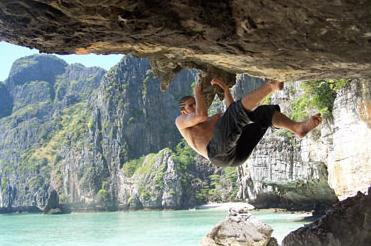
The above photo is of ropeless rock climbing at Phi Phi in Thailand, where my mom is vacationing right now, actually. But it's not free soloing, because the guy is low enough that he could fall without getting severely hurt or dying.
Free soloing... okay, fine, here's the awesome photo from the National Geographic. I'm not sure if they allow others to use their images. If they give me trouble, I'll take it down. Until then:
Now take a look at the article that goes along with that photo. Free soloing is stupid, scary, and awe-inspiring.
The article goes on from free soloing to talk about other rock climbing styles that are less stupid. Feeling inspired, I went on to find this video of Lynn Hill and Katie Brown climbing together. Lynn Hill is one of the best climbers in the world, and is mentioned in the National Geographic article. May she inspire you as she inspires me:
I have too many things I could write about this week. I could write about calligraphy, Brookhaven National Laboratory, rock climbing in Yosemite, flying dudes with jetpacks, Mars, Lapland... What to choose?
Jetman
Let's start with jetpacks, because what I have to say is short and sweet. All I really have to say is that this video is the closest I have seen people become to the goal of actually being birds:
Brookhaven National Laboratory
Okay, that's over with. Now I'll just talk about Brookhaven National Laboratory (BNL), because that's where I am right now. I'm here as part of my grad school research. For those who care, I'm at the National Synchotron Light Source (NSLS), at "Beamline X21." I do this thing called grazing incidence small angle x-ray scattering (GISAXS). Yes, science is full of acronyms (SIFOA).
The NSLS facility has two electron storage rings. One of them makes x-rays and one makes UV photons. There is technically also a third ring called the "booster ring" that injects electrons into the other rings, and I think the booster ring gives off infrared light. Anyway. Rough floorplan of my world of rings:
I work on the x-ray ring. Electrons fly around in circles in the ring, creating x-rays in the direction of electron propagation. When the electron beam is deflected a bit to continue moving around the ring, some x-rays fly out, basically (see the lines in the above floorplan). Each of these locations has a number; mine is X21. We use the x-rays to look at the surfaces of materials.
A sample section of beamline.
For some of you, that was too much science, and for some of you, it wasn't enough. Moving on.
The x-rays are all very carcinogenic and dangerous, so we have large amounts of lead shielding and piles of lead bricks to contain any potential escaped rays. Furthermore, if you want to let x-rays into the X21 "hutch" to do Science, there is a 5-step ENGAGE THE BEAM process that involves pressing three buttons and turning two keys while the lights in the hutch go off, an ominous red light goes on, and a long warning beep plays. The end result is that we're all very safe and we feel like Science is happening.
Sometimes the beam runs out of electrons. If there's a dip in power or if someone hits one of the Big Red Buttons, the electron beam gets "dumped." (I don't actually know where they get dumped. Over at the big RHIC ring in the northern half of BNL, their beam gets dumped into piles of lead bricks, and I suspect something similar happens at the NSLS.) One of the most popular conversation topics at the NSLS is, therefore, the status of the beam.
You know how all rowers can talk about around each other is catching crabs, the choppiness of the water, and their 2k times? At the NSLS, people are like that with the beam. When I first arrived here, the beam had been down for most of a day for some reason. One of the first conversations I overheard went something like this: "How's your research going?" "Oh, it's alright, but the beam has been in and out. Now that the beam's back up, it is progressing. Long hours tonight, but at least we have the beam!" It's like in Stephen King's Dark Tower series: All things serve the beam. I wouldn't be surprised if somewhere along the ring, some superstitious scientist had set up a little shrine to the beam.
There are also planned beam downtimes. Electrons get injected into the ring, but then over time, the electron current decays. To keep the current high and the Science going strong, the beam is taken down every morning and evening at 7. An announcement goes out over the loudspeakers, the beam gets dumped, and the "booster ring" I mentioned earlier starts injecting fresh new electrons. Once a certain number of electrons have been injected, the beam goes back up and Science resumes.
We tend to plan our dinners around the 7pm beam dump. And since 7pm nears, I'll be back in a bit...
...okay, I'm back. The beam is full of brand new electrons.
Some data I took! You can tell it's real Science because it looks like a rocket ship.
Parallels to Lost(A couple days later, back in Cambridge)
Brookhaven National Laboratory reminds me strangely of the Dharma Initiative from the TV show Lost. It is sort of a science commune. There are large, manicured lawns. There's a cafeteria, fitness center, swimming pool, and lounge, and people can stay in apartments or dormitories on-site.
While I didn't see any Dharma polar bears around, BNL is full of wild animals. No, I don't mean grad students -- they mostly keep to themselves as long as you don't interfere with their primary functions: taking data and eating Cup O' Noodles. What I actually mean is that the BNL campus is full of deer, groundhogs, raccoons, wild turkeys, geese, and fireflies. And also, uh, deer ticks full of lyme disease, but fortunately I avoided those this time around.
The animals are quite tame. A buck walked up to about 10 feet away from me and stared at me curiously. A groundhog flopped down on its belly right next to the sidewalk and went to sleep. And when we were entering the BNL campus for the first time, the flock of geese walked halfway across the road and casually sat down and refused to budge, stopping traffic in both directions for a bit. These animals are tame enough that I'm considering bringing them to my thesis defense in a few years. Maybe I could come in riding a buck.
Overall, the trip was fairly enjoyable. My collaborator and I worked 12- to 15-hour days, but we got 7-8 hours of sleep each night and had a good dinner each evening. I got in a few workouts to keep myself alive and awake, and spent some time outside when I could. We also got some good data from what we can tell so far, and we had good luck with the beam.
I'm told BNL trips can get a lot more stressful if you've got a big deadline ahead of you, but this time, we had a good time! At least, as good a time as you can have when you're working 12- to 15-hour days for a week. As proof, I present the balloon we made from leftover krypton at the end of the run:
(Note to all advisors and scientists who may be reading this: this balloon was filled with the extra krypton in the gas line at the end of the run! We did not waste expensive gas of 99.99999% purity to make balloons!)
(Note to non-scientists: krypton gas is inert, don't worry. Kryptonite, of course, is another story.)
Hello, blog readers. I said I would write about a hike in Washington...but I left that coast without downloading the relevant photos, and I cannot currently find the battery charger for my camera, so I have no interesting photos for you. A shame; there was much talus in that set of photographs. Now, either I get to post a boring and pictureless essay about a hike you cannot visualize, or I can post something entirely different. I will post about my intense ski craving!
These years when I get ski cravings in June are always tough. It is just So Very Long until late November, and these cravings persist. Really, it is a problem.
So, my thoughts naturally turn to summer skiing. I hear you can do that in the southern hemisphere. Or in the far, far North. For example, here is Las Leñas, in Argentina:
It comes with its own wintery ski village, and its season is June-October.
Seems cozy. It would suffice. Or hey, Whistler Blackcomb is open 11am-1:30pm each day. That is basically no time, but on the other hand, just thinking about the words "Whistler Blackcomb" makes me want to go buy plane tickets. Whistler in the summer, people:
Alright, fine, I may have a problem. And maybe I shouldn't buy plane tickets to Whistler for only 2.5 hours of skiing each day. (Round trip airfare to Vancouver is about $500 right now. Yes, I checked.) I will resign myself to feeling uncomfortably nostalgic for skiing from now until late November. In the meantime, I will post this photo of my last ski trip, to Mount Sunapee in New Hampshire:
Feel free to click on it for the larger view, because many-pixel ski photos are great. I will also post this photo of my amazing and wonderful skis:
Mine are the excellent black-and-orange ones in the middle.
Sigh. You know, some of you people out there could convince me to block off a week of my summer for a ski vacation... until then, back to work I guess.
My camera ran out of batteries and my charger is in another state, so I can't post photos from a hike up Mt. Hamilton this past blogging period. Instead, I will talk about a German guy talking about French caves.
I saw a documentary (in 3-D!) called "Cave of Forgotten Dreams" directed by a guy with a cool voice, Werner Herzog. Some explorers were measuring the windy drafts in some French hills in search of caves -- unexplained drafts could be a sign that there is a cave structure nearby. They came across a Chauvet Cave, which contains the oldest cave paintings ever discovered, some older than 30,000 years old. 30,000 years ago, during the Paleolithic Period, there were still Neanderthals competing with early homo sapiens. Wooly mammoths and huge cave bears roamed the earth, which was in the middle of an ice age. Hunting was done with spears and spear-throwing sticks. And some early Frenchmen were painting on the walls. (What were they painting with? The documentary was unclear about this. I think charcoal, though some of the paintings were red.)
The paintings were then sealed off from the external environment by a landslide. (How did explorers sense drafts from the cave if it was sealed? The documentary was unclear about this. I guess there were very small openings.) In the closed-off environment, mineral deposits started forming stalagmites and stalagtites and thin crusts of calcite on top of things. One cave bear skull became covered in about an inch of mineral stuff over the years, affixing it to the floor. Fossilized cave bear footprints were also found.
Carbon dating showed that the paintings came from two periods about 5,000 years apart. People came across cave paintings that were already what we might consider ancient these days, and they painted right next to them. It's sort of as if you found original art from the first Egyptian dynasty and decided to doodle on it.
The painters used the natural curvature of the cave walls to guide their painting. A frequently-cited example of this technique is the panel of the horses, though you cannot see the curvature much here:
The chamber of the lions was also quite impressive:
Also in the chamber of the lions was a painting on a stalagtite of a naked woman with a bull's head:
(If that's confusing, you're looking at the lower half of a woman, with a bull's head somewhere in her stomach.)
Werner Herzog was also so kind as to bring in a man dressed in ice-age-style reindeer furs to demonstrate a replica of a flute found in the cave. Just looking at Werner and his guest, you might be able to see that this was an entertaining segment of the film:
I was trying to find some history to put 30,000 years ago in perspective, and what I found is that that's about as old as the earliest pottery, and it's about the time that people started living in Japan. I still don't think I have a good sense of how long 30,000 years is. If anyone has a better way of thinking about this, post a comment.
Until then, I'll leave you with this painting of a horse, scratched by a cave bear: